Forthcoming book
CONSCIOUS
ADOPTION
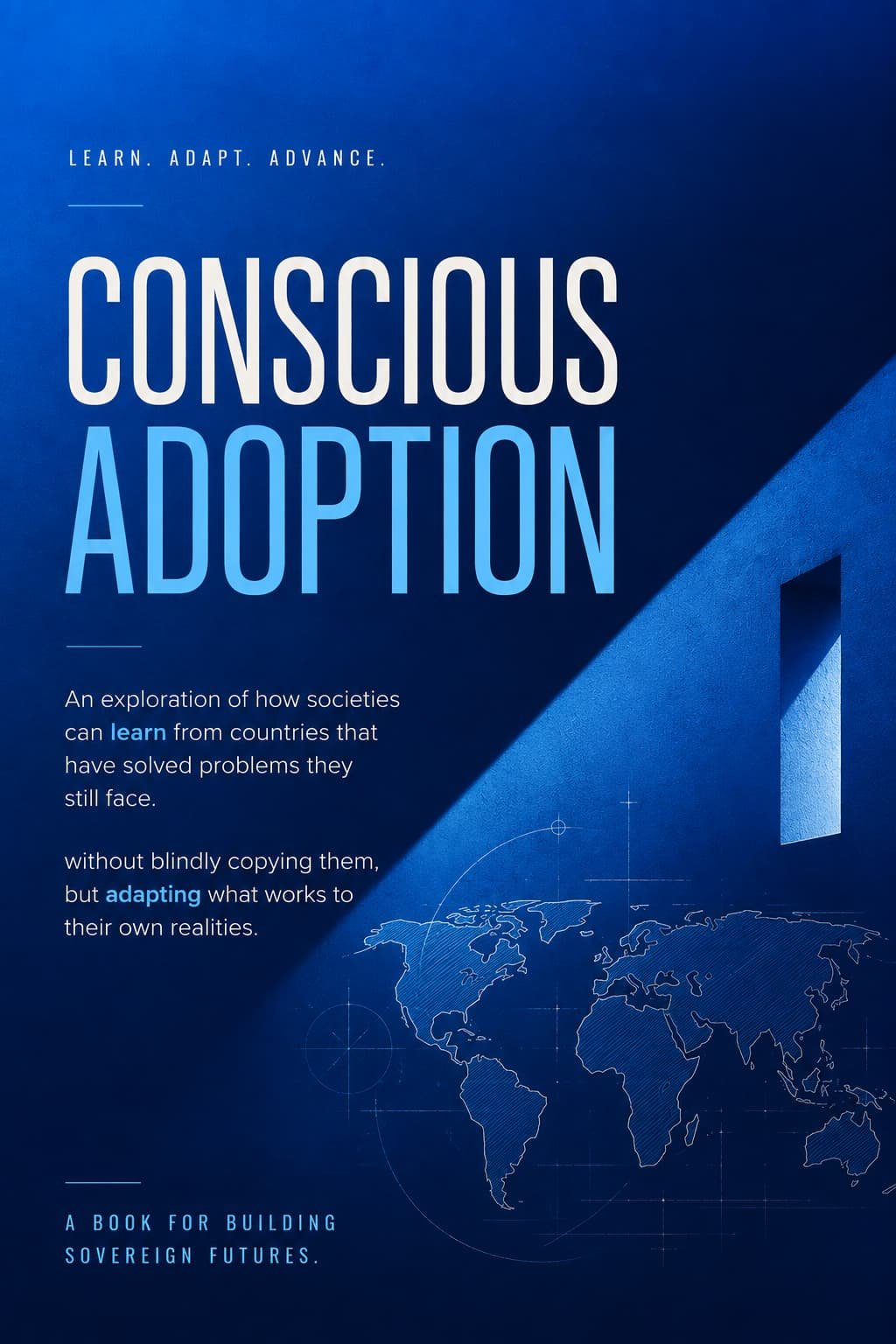
The idea behind the book
Learn from anyone. Copy no one blindly.
This is an explanation of a future project, not a finished book.
Conscious Adoption is about how societies can learn from what works elsewhere without surrendering their judgement, identity, or independence.
Back to books ↗01
The position
There are two reactions to the success of other societies that can be equally limiting.
One is rejection: dismissing foreign ideas because they came from outside, treating successful institutions as culturally inappropriate before asking what they actually do, or allowing history to decide what we are permitted to learn.
The other is imitation: assuming that because another society succeeded, everything it did must be superior and should be copied wholesale.
Conscious Adoption is a third position. It means looking at the world without worshipping it and without hating it. It means asking what other societies faced, how they responded, what worked, what failed, why it worked, why it failed, and what we can actually use.
Learn from anyone, copy no one blindly.
02
What it requires
Conscious adoption begins with humility. Other societies have solved problems that we have not. There is nothing embarrassing about admitting that.
It requires curiosity. If someone has achieved something we want, we should want to understand how they did it.
It requires scepticism too. A successful country is not necessarily right about everything, and an institution that works in one environment may fail in another.
And then comes experimentation. We adapt ideas, test them against our own circumstances, keep what works, and discard what does not.
That gives us a different relationship with the outside world. We do not need to approach other societies with resentment. We do not need to approach them with admiration either. We can simply study them.
03
The questions
What problem were they trying to solve? What did they do? Why did it work? What conditions made it possible? What went wrong? What would have to change for something similar to work here?
If China has solved a problem we have not solved, we should study China. If Singapore has built an institution that works better than ours, we should study Singapore. If Japan adapted foreign technology and turned it into domestic capability, we should understand how. If an African country has solved a problem better than everyone else, we should study that too.
We should not care who solved the problem first. We should care whether the solution works, why it works, and whether we can adapt it to our own circumstances.
The lesson can come from anywhere. The goal is not to import another society. It is to understand how something works well enough to decide whether, and how, it can be adapted to our circumstances.
04
Agency, not imitation
Rejecting knowledge simply because it comes from outside Africa is self-defeating. But accepting an idea simply because it worked somewhere else is equally foolish.
Conscious adoption is not surrender. It is a form of agency: being open enough to learn and independent enough to decide.
It is not isolation. It is not imitation. It is not permanent resistance. It is the independence that allows us to look at the world, take what is useful, reject what is not, and build according to our own interests.
Study it. Understand it. Adapt it. Improve it. Make it ours.
05
A companion idea
Conscious Adoption is closely connected to Saving Africa. If Saving Africa asks how African societies can become capable of solving their own problems, Conscious Adoption asks how they can learn from the world while remaining free to choose their own path.
An idea can be successful somewhere else and still be wrong for us. The work is to understand the difference between copying an outcome and understanding the conditions that produced it.
That is the balance this future book wants to explore: openness without dependence, judgement without arrogance, and independence without isolation.
Stay close to the work
FOLLOW THE INVESTIGATION
Get new films, field notes, and research from Ziyad Yakubu.