Forthcoming book
SAVING
AFRICA
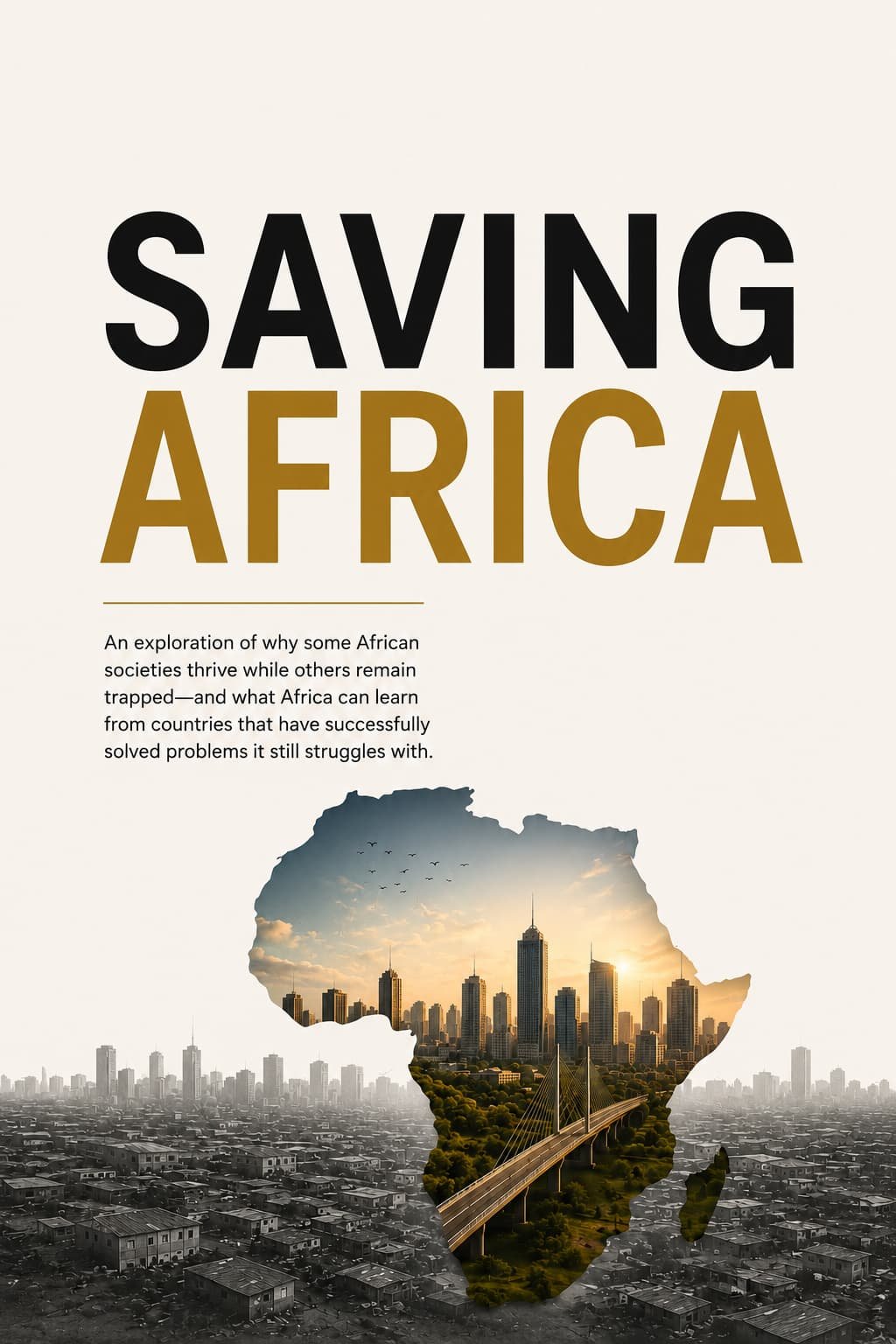
The idea behind the book
The question behind the question.
This is an explanation of a future project, not a finished book.
How do we save Africa? It is a simple question to ask, but a difficult one to answer. This project begins by asking a more uncomfortable question: why do problems that exist everywhere become so painful, so persistent, and so difficult to solve in Africa?
Back to books ↗01
The question behind the question
There is a question that has followed Africa for generations. It is asked by politicians, activists, intellectuals, entrepreneurs, revolutionaries, development experts, religious leaders, philanthropists, and ordinary Africans who look around their societies and see enormous potential constrained by enormous problems.
The wording changes from person to person. Some ask how Africa can escape poverty. Others ask how it can end corruption, defeat neocolonialism, build strong institutions, industrialise, educate its people, develop its infrastructure, become technologically independent, or finally exercise meaningful sovereignty over its own affairs.
Some believe the answer lies primarily outside Africa. They point to colonialism, slavery, unequal trade, foreign intervention, multinational corporations, international financial institutions, military intervention, geopolitical competition, or the continued influence of powerful states.
Others look inward. They point to incompetent governments, weak institutions, corruption, ethnic politics, poor education, bad incentives, ineffective bureaucracies, weak infrastructure, insecurity, demographic pressures, and the failure of African elites to build systems capable of producing sustained prosperity.
There are also those who believe the problem is fundamentally psychological or cultural. They argue that Africa must recover its confidence, restore its identity, reject foreign standards, revive indigenous traditions, or develop a stronger sense of collective purpose. And then there are those who believe the solution is some combination of all these things.
I understand the appeal of each argument. But I have become increasingly dissatisfied with the way the question is usually framed.
Take oil. Nigeria, Angola, Libya, Algeria, and Saudi Arabia all have oil. So why does oil create dependence, economic stagnation, and elite capture in Nigeria while it produces state capacity, global influence, and high standards of living in Saudi Arabia?
The same applies to corruption. Corruption exists in African countries, but it also exists everywhere else. So why did corruption not stop China from transforming itself from a predominantly poor, agrarian society into an industrial and technological superpower in less than four decades? Why did it not stop China from lifting 800 million people out of extreme poverty in one generation, building one of the world’s largest infrastructure networks, becoming the world’s manufacturing centre, and becoming a major exporter of everything from basic consumer goods to high-speed trains, electric vehicles, batteries, telecommunications equipment, and advanced technology?
Geography, colonialism, greedy elites, ethnic, linguistic, and religious fragmentation, foreign intervention, neocolonial economic relationships, and other challenges have been faced by many societies. Why, then, have they led to the kind of stagnation and underdevelopment we see in Africa?
That is the problem this book wants to confront.
02
Why us?
There is another question underneath all of this: why always us?
Africans experienced slavery, colonialism, racial segregation, apartheid, economic exploitation, and repeated foreign intervention. Many African countries still struggle with poverty, insecurity, weak institutions, political instability, and economic dependence.
It is understandable that this history produces anger. It is understandable that it produces suspicion. It is understandable that Africans look at the accumulated record and ask why so much suffering seems to have been concentrated here.
But there are two very different categories of questions we can choose to ask.
We can scrutinise history. What conditions made these outcomes possible? How did foreign powers acquire so much influence? Why were African states unable to resist it? How did those arrangements survive independence? These are questions we should be asking.
Or we can become trapped asking something else: why does the world keep doing this to us?
This question is much less useful because it places the explanation almost entirely outside ourselves.
I am not interested in pretending that international politics is fair. It is not. Countries pursue their interests. Powerful countries have more ability to impose their preferences on weaker countries than weaker countries have to impose theirs. Governments protect strategic, economic, and security interests. Companies pursue profit. States use whatever advantages they possess.
Africa has interests too. We should defend them. But that immediately raises a question that is often neglected: what does it take for African countries to have enough power to pursue their interests effectively?
If another country can dictate the terms of an investment, why can it? If foreign governments can influence our politics, why are they in a position to do so? If multinational companies can negotiate with African governments from a position of overwhelming strength, why? If African countries struggle to coordinate their interests, why? If governments cannot finance their own priorities, why? If African companies cannot compete internationally, why?
The point is not to excuse the stronger actor. The point is to understand the weakness that makes the stronger actor so consequential.
External power is real. But it matters most when internal capacity is weak. That is part of the problem we have to be willing to examine.
03
Two ways of looking at the world
I have noticed two broad reactions to this problem.
The first is rejection. Some Africans have responded to our history by rejecting almost everything associated with the outside world. They reject foreign institutions because they are foreign. They dismiss foreign ideas because they came from the West. They treat successful institutions developed elsewhere as culturally inappropriate before asking what those institutions actually do or why they work.
There is also a tendency to romanticise the precolonial past, to treat everything foreign as exploitation, and to turn anti-colonialism into an identity. Once that happens, evidence becomes secondary. An idea can be rejected simply because a European or American developed it, while an ineffective idea can be defended because it feels authentically African.
That does not produce independence. It produces another kind of dependence: allowing our history to decide what we are permitted to learn.
But there is another reaction that is just as limiting. Some Africans respond to the success of Western societies by idealising them. They look at wealth, institutions, technology, infrastructure, and military power and conclude that because these societies succeeded, they must have been right. Their institutions become inherently superior. Their historical choices become evidence of their wisdom. Their material success becomes a justification for the systems that produced it.
Some even go as far as arguing that Africa should never have become independent. They point to the infrastructure built under colonial rule and the administrative systems colonial governments established. They compare the conditions of some African countries today with the conditions under colonial governments and conclude that colonialism was preferable.
That argument confuses outcomes with justification.
A colonial government could build a railway because the railway served its economic interests. That does not make colonial rule benevolent. A country can become extraordinarily wealthy while exploiting other societies. A state can build highly capable institutions while denying millions of people basic rights. A society can accomplish extraordinary things without everything it did being worthy of imitation.
We should not make those things equivalent. We can acknowledge that a colonial government built something useful without concluding that colonialism was good. We can acknowledge that Western societies developed institutions that work without concluding that Western civilisation is inherently superior. We can recognise China’s extraordinary economic transformation without adopting Chinese political institutions wholesale.
The same principle applies in the other direction. The fact that something is foreign does not make it bad. Just because something is African does not make it good. The fact that something worked does not make it morally right. The fact that something was morally wrong does not mean that every consequence of it was useless. And the fact that another society succeeded does not mean that everything it did deserves to be copied.
This is why I want a third position: to look at the world without worshipping it and without hating it.
04
The ability to choose
I want to ask what other societies faced, how they responded, what worked, what failed, why it worked, why it failed, and what we can actually use.
If China has solved a problem we have not solved, we should study China. If Singapore has built an institution that works better than ours, we should study Singapore. If Japan adapted foreign technology and turned it into domestic capability, we should understand how. If an African country has solved a problem better than everyone else, we should study that too.
We should not care who solved the problem first. We should only care whether the solution works, why it works, and whether we can adapt it to our own circumstances.
Study the world without worshipping it or hating it.
There is an irony in the two reactions described above. They appear to be opposites, but both remain preoccupied with the same external reference point.
One says, “Reject them.” The other says, “Become like them.” One defines Africa in opposition to the West. The other defines African progress through comparison with the West. In both cases, Africa is still reacting.
Political independence does not automatically produce intellectual independence. If our political imagination is limited to either imitating another society or opposing it, then we have not developed the freedom to examine the world on our own terms and decide what is useful.
That is the kind of agency I am interested in. Not the ability merely to resist. Not the ability merely to imitate. The ability to choose.
05
The limits of protest
None of this is an argument against protest. Protest has changed history, and some of the most important freedoms we enjoy today were won through resistance.
Africans and people of African descent resisted slavery, colonial rule, segregation, apartheid, and other forms of oppression for generations. They organised, marched, rebelled, fought, wrote, spoke, and refused to cooperate with systems they considered unjust. Those struggles mattered. They changed laws, brought down governments, and expanded the boundaries of what was politically possible.
But protest has a limit.
After independence, African countries still had to govern themselves. They had to build functioning administrations, courts, schools, power systems, industries, transport networks, and economies capable of creating wealth. Those things did not appear simply because colonial rule had ended.
This is where I think the language of resistance can become limiting. We can become so accustomed to explaining Africa through oppression that resistance starts to feel like the answer to every problem.
Colonialism, foreign interference, racism, and exploitation all matter. There are legitimate grievances against African governments and foreign powers alike. But identifying the forces that have held us back is different from developing the capacity to overcome them.
A country can spend years debating its history and still have unreliable electricity. It can produce excellent arguments about exploitation and still lack productive industries. It can celebrate its ancestors and still struggle to educate its children, enforce its laws, or build infrastructure.
Eventually, the question becomes practical: what can we actually do?
That requires a different kind of attention. We have to understand how institutions are designed and why some of them work better than others. We have to learn how countries industrialised, how bureaucracies became competent, how infrastructure was financed, how technology was developed, and how governments acquired the ability to execute decisions.
Those are some of the questions I aim to tackle in the book.
06
What are we actually trying to achieve?
This is why I do not want this book to become another catalogue of African grievances. We have plenty of those.
The objective is not difficult to identify. We want prosperity. We want security. We want functioning governments and productive economies. We want African businesses that can compete internationally. We want our resources to generate wealth rather than simply being extracted and exported. We want governments capable of providing basic services and defending national interests. We want our children to have opportunities that previous generations did not have.
None of that is controversial. The difficult part is figuring out how to get there.
And that is where motives become less important than methods.
Most people who care about Africa do not disagree about the desired destination. They disagree about what will actually get us there. That means we need to become much more serious about asking whether our methods work.
Sometimes we have confused opposition with strategy. Sometimes we have confused independence with capacity. Sometimes we have rejected foreign influence without building the capabilities necessary to replace it. Sometimes we have admired successful countries without taking the time to understand what actually made them successful.
Good intentions are not enough. Wanting Africa to prosper does not tell us how to make African economies productive. Wanting sovereignty does not tell us how to build states capable of defending their interests. Wanting better government does not tell us how to construct institutions that can actually deliver it.
Those are engineering problems as much as political ones. And engineering requires studying what works.
07
Look at what works
If another society has solved a problem that we have not solved, why would we refuse to study it?
I do not care who solved it first. I do not care whether I like their government. I do not care whether they share our history, religion, ethnicity, or political ideology. If they have figured something out, I want to understand how they did it.
That does not mean copying them. Copying is easy. Understanding is harder.
Suppose we look at South Korea. I do not want to conclude that Africa should simply “become South Korea.” That tells us almost nothing. I want to know what actually happened.
How did South Korea build industrial capacity? What did the state do? What did private companies do? How important were exports? What happened in education? What role did international conditions play? Which policies were deliberate? Which were responses to circumstances that Africa does not share?
Then we can separate the things that were specific to Korea from the principles that might be useful elsewhere.
The same approach can be applied to China, Japan, Singapore, the United States, India, Europe, Rwanda, Botswana, Ethiopia, or any other society that has solved a problem we still struggle with. The lesson can come from anywhere.
That principle matters because rejecting knowledge simply because it comes from outside Africa is self-defeating. But accepting an idea simply because it worked somewhere else is equally foolish.
We need judgement. The goal is not to import another society. It is to understand how something works well enough to decide whether, and how, it can be adapted to our circumstances.
08
Saving Africa
When I say “saving Africa,” I am not imagining a heroic figure arriving with a cape to rescue a helpless continent. I am not proposing one ideology or one policy that will somehow solve everything. And I am certainly not arguing that Africa should become a copy of another civilisation.
I mean something more basic. I want African societies to become capable of dealing with the world on their own terms.
That means being able to recognise exploitation without becoming consumed by the people doing the exploiting. It means being able to acknowledge our own failures without turning that into self-hatred. It means studying successful societies without assuming they are morally superior. It means studying our own history without allowing it to imprison us.
Most importantly, it means becoming willing to learn from wherever useful knowledge exists.
If Saudi Arabia has developed ways of managing an oil economy that Nigeria could learn from, study them. If China has become exceptionally good at building infrastructure, study how. If Singapore has developed unusually capable institutions despite serious constraints, understand what made that possible. If South Korea transformed itself from poverty into an industrial economy, find out how. If Japan developed technological capabilities by adapting knowledge from elsewhere, study that process. And if an African country has solved a problem better than the rest of the world, study that too.
There is no shame in learning. The only thing we should be ashamed of is allowing pride to prevent us from learning something useful.
But learning does not mean surrendering judgement. An idea can be successful somewhere else and still be wrong for us. Conscious adoption means being open enough to learn and independent enough to decide.
That is the balance I am looking for. Not isolation. Not imitation. Not permanent resistance. Independence.
The kind of independence that allows us to look at the world, take what is useful, reject what is not, and build according to our own interests.
Study it. Understand it. Adapt it. Improve it. Make it ours. Then move on to the next problem.
And perhaps that is what saving Africa actually means. Not saving Africa from foreigners. Not saving Africa from Africans. Building African societies that are capable of dealing with both.
An Africa capable of understanding the forces acting upon it, recognising its own weaknesses, defending its interests, learning from whoever has something useful to teach, and turning that knowledge into institutions, businesses, technology, infrastructure, and productive economies of its own.
The objective is not to prove that Africa is better than everyone else. It is not to prove that Africa was wronged. History has already settled that question. And it is not even to prove that Africa can become another America, China, Europe, Singapore, or South Korea.
The objective is simpler: to make African societies capable of solving their own problems.
If someone else has already solved one of those problems, there is no virtue in suffering through it again simply because they solved it first.
That is the project. And that is where this book begins.
Stay close to the work
FOLLOW THE INVESTIGATION
Get new films, field notes, and research from Ziyad Yakubu.